
BA(HON’S) English Syllabus
- Home
- BA(HON’S) English Syllabus
B. A. (Hon’s) degree in English is a four year program. There will be 10 Foundation courses, 24 Core courses and 7 Elective courses of a total value of 123-credit consisting of 4100 marks. All the courses are compulsory. Students are required to obtain at least D grade (40 to less than 45 marks) for the Hon’s Degree. A final examination will be held at the end of every semester for each course. There will be a mid-term examinations and an oral examination in every semester.
Marks Distribution for each (3 credits) course
- 2 midterm Examinations of 15 marks = 15x2=30
- Class Attendance & Presentation = 10
- Semester Final Examination = 40
- Assignment + Presentation = 10
- Viva-voce = 10
Grand Total = 100 for each 3 credit course
(1st Semester)
| S.L | Course Code | Name of the Courses | Credit | Marks |
|---|---|---|---|---|
| 1 | ENG 101 (F-3) | Communicative English Grammar | 3 | 100 |
| 2 | ENG 102 (F-1) | Four Skills (Listening & Speaking; Reading & Writing) | 3 | 100 |
| 3 | ENG 103 (F-6) | Introduction to Poetry | 3 | 100 |
| 4 | ENG 104 (E-2) | History of English literature | 3 | 100 |
| 5 | ENG 105 (E-1) | Emergence & History of Bangladesh | 3 | 100 |
| Total | 500 |
(2nd Semester)
| S.L | Course Code | Name of the Courses | Credit | Marks |
|---|---|---|---|---|
| 1 | ENG 106 (F-2) | Spoken English & Phonetics | 3 | 100 |
| 2 | ENG 107 (F-9) | Academic Writing (Preparing for the AP English Language and composition Exam) | 3 | 100 |
| 3 | ENG 108 (F-10) | Introduction to Prose & Drama | 3 | 100 |
| 4 | ENG 109 (C-19) | Introduction to Linguistics | 3 | 100 |
| 5 | ENG 110 (E-5) | Bangladeshi Art & Culture | 3 | 100 |
| Total | 500 |
(3rd Semester)
| S.L | Course Code | Name of the Courses | Credit | Marks |
|---|---|---|---|---|
| 1 | ENG 207 (F-8) | English for Professional purposes (English at work in Asia: Job interviews) | 3 | 100 |
| 2 | ENG 208 (F-7) | Studies in English History | 3 | 100 |
| 3 | ENG 209 (E-6) | Introduction to Sociology & Anthropology | 3 | 100 |
| 4 | ENG 210 (C-7) | Romantic Poetry | 3 | 100 |
| 5 | ENG 211 (C-6) | Restoration and 18th Century Literature | 3 | 100 |
| Total | 500 |
(4th Semester)
| S.L | CourseCode | NameoftheCourses | Credit | Marks |
|---|---|---|---|---|
| 1 | ENG207(F-8) | EnglishforProfessionalpurposes(Englishat workinAsia:Jobinterviews) | 3 | 100 |
| 2 | ENG208(F-7) | Studies in EnglishHistory | 3 | 100 |
| 3 | ENG209 (E-6) | IntroductiontoSociology &Anthropology | 3 | 100 |
| 4 | ENG210(C-7) | Romantic Poetry | 3 | 100 |
| 5 | ENG211(C-6) | Restorationand18thCenturyLiterature | 3 | 100 |
| Total | 500 |
(5th Semester)
| S.L | Course Code | Name of the Courses | Credit | Marks |
|---|---|---|---|---|
| 1 | ENG 301 (E-7) | Introduction to Bengali Literature | 3 | 100 |
| 2 | ENG 302 (E-3) | Basic Philosophical Concept | 3 | 100 |
| 3 | ENG 303 (C-16) | Western Classics in Translation | 3 | 100 |
| 4 | ENG 304 (C-15) | Literary Criticism and Theory | 3 | 100 |
| 5 | ENG 305 (C-9) | Victorian Prose & Poetry | 3 | 100 |
| Total | 500 |
(6th Semester)
| S.L | Course Code | Name of the Courses | Credit | Marks |
|---|---|---|---|---|
| 1 | ENG 306 (C-10) | English Novel from Austen to Hardy | 3 | 100 |
| 2 | ENG 307 (C-11) | American Literature- (Poetry) | 3 | 100 |
| 3 | ENG 308 (C-17) | Asian Classics in Translation | 3 | 100 |
| 4 | ENG 309 (C-23) | Language and Media | 3 | 100 |
| 5 | ENG 310 (C-4) | Elizabethan & Jacobean Drama | 3 | 100 |
| Total | 500 |
(7th Semester)
| S.L | Course Code | Name of the Courses | Credit | Marks |
|---|---|---|---|---|
| 1 | ENG 401 (C-10) | Modern English Literature | 3 | 100 |
| 2 | ENG 402 (C-20) | Introduction to English Language Teaching (ELT) | 3 | 100 |
| 3 | ENG 403 (C-13) | South Asian Literature in English | 3 | 100 |
| 4 | ENG 404 (C-12) | American Literature- (Fiction & Drama) | 3 | 100 |
| 5 | ENG 405 (C-24) | Discourse Analysis & Pragmatics | 3 | 100 |
| Total | 500 |
(8th Semester)
| S.L | CourseCode | NameoftheCourses | Credit | Marks |
|---|---|---|---|---|
| 1 | ENG406(C-14) | African andCaribbean LiteratureinEnglish | 3 | 100 |
| 2 | ENG407(C-21) | Teaching Second Language Skills | 3 | 100 |
| 3 | ENG408(C-22) | Teaching Language through Literature | 3 | 100 |
| 4 | ENG409(C-3) | Renaissance Prose & Poetry | 3 | 100 |
| 5 | ENG410(C-18) | Latin American Classics in Translation | 3 | 100 |
| Total | 500 |
| Year | 1st Semester | Credit | 2nd Semester | Credit | Total Marks | Total Credit |
|---|---|---|---|---|---|---|
| 1st | 500 | 15 | 500 | 15 | 1000 | 30 |
| 2nd | 600 | 18 | 500 | 15 | 1100 | 33 |
| 3rd | 500 | 15 | 500 | 15 | 1000 | 30 |
| 4th | 500 | 15 | 500 | 15 | 1000 | 30 |
| Grand Total | 4100 | 123 |
Duration of Terms:
The duration of each of term will be as follows:
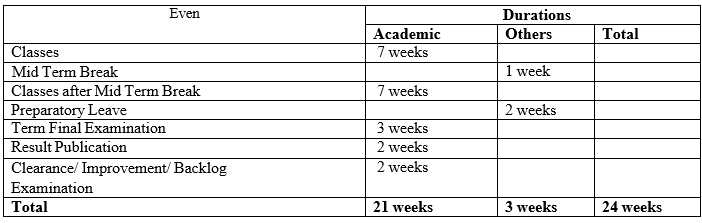
Degree Requirements:
To obtain the BA (Hon’s) in English degree a student will have to complete minimum 123 credits. Minimum credit requirements for the award of bachelor’s degree in BA (Hon’s) in English will be decided as per existing rules. The minimum CGPA requirement for obtaining a Bachelor’s degree is 2.20. A student is required to complete the whole course within 4 (four) years (8 terms). For an unavoidable case if a student fails to complete the course within stipulated time of 4 years he/she must complete all degree requirements within a maximum period of 6 (six) academic years (12 terms). Failure to complete all degree requirements within the given time frame may disqualify a student from continuation of his/her study at the University
The Grading System:
The total performance of a student in a given course is based on a scheme of continuous assessment. For theory courses this continuous assessment is made through a set of quizzes, class evaluation, class participation, homework, assignment and a term final examination. The assessment in laboratory courses is made by evaluating performance of the student at work during the class, viva-voce during laboratory hours and quizzes. Each course has a certain number of credits, which describes its corresponding weightages. A letter grade with a specified number of grade points is awarded in each course for which a student is registered. A student’s performance is measured by the number of credits completed satisfactorily and by the weighted average of the grade points earned. A minimum grade point average (GPA) is essential for satisfactory progress. 60/36/48 credits have to be acquired in order to qualify for the degree. Letter grades and corresponding grade points will be awarded in accordance with the provisions shown below:
| Obtained Marks | Letter Grade | Grade Point | Interpretation |
|---|---|---|---|
| 80% and above | A + (A plus) | 4 | Outstanding |
| 75% to less than 80% | A (A regular) | 3.75 | Excellent |
| 70% to less than 75% | A – (A minus) | 3.5 | Very Good |
| 65% to less than 70% | B + (B plus) | 3.25 | Good |
| 60% to less than 65% | B (B regular) | 3 | Satisfactory |
| 55% to less than 60% | B – (B minus) | 2.75 | Above Average |
| 50% to less than 55% | C + (C plus) | 2.5 | Average |
| 45% to less than 50% | (C regular) | 2.25 | Below Average |
| 40% to less than 45% | D | 2 | Pass |
| Less than 40% | F | 0 | Fail |
| Incomplete | I | - |
|---|---|---|
| Withdrawal | W | - |
Medium of Instruction and Examination: The medium of instruction will be in English.
Duration of Examination:
Examination will be held on term basis. Time allotted for the Examination will be as follows:
*Mid-term: 1 Hour for 15 Marks
*Semester Final: 2 Hours for 40 Marks
Attendance:
All students are expected to attend classes regularly. The University believes that attendance is necessary for effective learning. The first responsibility of a student is to attend classes regularly, and one is required to attend at least 75% of all classes held in any course, otherwise he/she will not be allowed to sit for the Final Examination.
| 1stSEMESTER | ||||
|---|---|---|---|---|
| S.L | CourseCode | NameoftheCourses | Credit | Marks |
| 1 | ENG101(F-3) | Communicative EnglishGrammar | 3 | 100 |
| 2 | ENG102(F-1) | Four Skills (Listening&Speaking; Reading&Writing) | 3 | 100 |
| 3 | ENG103(F-6) | IntroductiontoPoetry | 3 | 100 |
| 4 | ENG104(E-2) | Historyof Englishliterature | 3 | 100 |
| 5 | ENG105 (E-1) | Emergence & History of Bangladesh | 3 | 100 |
- 1
- ENG 101 (F-3)
- Communicative English Grammar
Course Content:
1. Sentence and sentence parts: (Sentence and its structure, construction, and patterns, Common types of sentences Clauses)
2. Nouns and Pronouns: ( Identification and classification of nouns, Pronoun types and usage, Pronoun-antecedent agreement Articles and Determiners)
3. Negation: (Creating negative statements, Double negatives, Negation with modal verbs)
4. Verbs and Verb Tenses: ( Regular and irregular verbs, Modals and auxiliaries, Subject-Verb Agreement, Verb tenses, Sequence of tenses)
5. Modifiers: Adjectives and Adverbs: (Formation of adjectives and adverbs, Adverbs and their uses, Adjectives and their uses, Comparison of adverbs and adjectives)
6. Prepositions: (Common prepositions and their usage, Phrasal verbs, Learning practicing idiomatic expressions)
7. Conjunctions: (Coordinating and subordinating conjunctions)
8. Active and Passive Voice: (Formation and use of active voice, Formation and use of passive voice, Appropriate use of active/passive voice in writing and speaking)
9. Direct and Indirect Speech: (Rules for changing direct to indirect speech, Indirect speech in different tenses, Indirect speech in different tenses)
10. Mastering Complex Sentences: (Independent and dependent clauses, Relative clauses, Clauses with conjunctions and relative pronoun Infinitives, gerunds, and conditionals)
11. Error Correction and Editing:
12. Vocabulary building: (Techniques to build vocabulary, Techniques for vocabulary retention, Prefixes, suffixes, or infixes, Compounding, Words and their functional shifts)
Prescribed Texts:
Patricia Werner & Lou Spaventa. Mosaic 1 Grammar. Michael McCarthy and Felicity O’Dell. Academic Vocabulary in Use
Recommended Readings:
- Communicative Grammar- Derewianka B. M.
- New Headway: Beginner A1: Student’s Book: Liz Soars, John Soars
- 2
- ENG 102 (F-1)
- Four Skills (Listening & Speaking; Reading & Writing)
Course Content:
1. LISTENING: Listening for the Main Idea and Factual, Information, Understanding Speakers’ Agreement, Responses and Attitudes, Form Completion, Listening for Numbers, Responding to different situations like greetings, introduction, seeking permission, asking for things, giving directions, asking information, Stress, Intonation, Sounds etc.
2. SPEAKING: The Interview: The Introduction
- Likes and Dislikes
- Extending Your Answer
- Esential Aspects
- Beginning Your Talk
- Ending Your Talk
3. READING: strategies (skimming, scanning, predicting, referencing, etc.) speed reading, active reading, Short Answer Questions ,
- Headings
- Global Multiple Choice Questions
- Locating Information
- True, False, Not Given
- Matching
Graph, Table, Pie, Column Chart; Academic Letter Writing, Organizing a paragraph/ essay: topic sentence, detailed sentences, logical order and conclusions.
Recommended Readings:
- Anderson, A & Louis, T (2007) Listening
- Binkow, H. (2000), Learns to Listen. Oxford University Press.
- Imhoof, M. &Hudson,H.: From Paragraph to Essay
- Joly L.: Writing Tasks
- Ship or Sheep an Intermediate pronunciation course
- New Headway Advanced Student's Book 4th
- 3.
- ENG 103 (F-6)
- Introduction to Poetry
Course Content:
| Course Content: | |
|---|---|
| 1. Rhetoric & Prosody | |
| 2. Shakespeare (1564-1616) | Sonnet 116, Sonnet 18: “Shall I compare thee to a summer’s day, Sonnet 130: “My mistress’ eyes are nothing like the sun”, Sonnet 147: “My love is as a forever, longing Still”. |
| 3. Thomas Gray (1716-1771) | Elegy Written in a Country Churchyard |
| 4. John Keats (1795-1821) | Ode on a Grecian Urn |
| 5. Robert Browning (1812-1889) | My Last Duchess |
| 6. T.S. Eliot (1888-1965) | The Love Song of j Alfred Prufrock |
| 7. John Donne (1572-1631) | The Good Morrow, The Sun Rising |
| 8. W. B. Yeats (1865-1939) | No Second Troy |
| 9. Dylan Thomas (1914-1953) | Fern Hill |
Recommended Books:
- Marjorie Boulton : Anatomy of Poetry
- M. H. Abram : A Glossary of Literary Terms
- William J. Long : History of English Literature
- Helen Vendler : The Art of Shakespearean Sonnets
- John Carey : John Donne: Life, Mind and Art
- L. C. Martin : Robert Herrick: Poems
- John Dixon Hunt : Andrew Marvel: His Life and Works
- B. C. Southam : A Student’s Guide to the Selected Poems of T. S. Eliot
- Dr. M. MofizarRahman : An ABC of English Literature
- Richard Gill : Mastering English Literature
- 4.
- ENG 104 (E-2)
- History of English literature
Course Content:
| Course Content: |
|---|
| 1. Old English Literature |
| 2. Middle English Literature |
| 3. The Renaissance Literature |
| 4. The Elizabethan Age |
| 5. The Restoration Literature |
| 6. The Metaphysical Poets & Poetry |
| 7. 18th Century Literature |
| 8. Romantic Period |
| 9. Victorian Period |
| 10. Modern Period (1901- Second Word War) |
| 11. Post-Modern Literature |
Recommended Books:
- LigouisCazamian : History of English Literature
- Benjamin I for Evans : A Short History of English Literature
- Boris Ford (ed.) : The Pelican Guide to English Literature
- Jorge Luis Borges : Introduction to English Literature
- William J. Long : English Literature, Its History and Its Significance
- 5.
- ENG 105 (E-1)
- Emergence & History of Bangladesh
Course Content:
2. Movements: Non-cooperation Movement
3. Background of liberation War: (The Lahore Resolution of 1940, The 1943 Bengal Famine)
4. Emergence of Pakistan: (Partition in 1947, and founding of Pakistan, Language Movement in 1952, National Elections in 1954)
5. Political Problems: (Promulgation of Martial Law in 1958, Rise of Bengali Nationalism, Six-Points Movement in 1966, Mass Uprising in 1969 and General Election in 1970)
6. Independence movement: (March 7 Speech by Bangabandhu Sheikh Mujibur Rahman, Declaration of Independence, Operation Searchlight, War of Liberation and Founding of Bangladesh, Formation of the Constitution of Bangladesh
Recommended Books:
- Rounaq, J : Pakistan Failure in National Integration
- Maniruzzaman, T : The Politics of Development
- Muhit, A. M. A : Bangladesh; Emergence of a New Nation
- Siddique, Kamal : Local Government of Bangladesh
- Khan. M. M : Bangladesh; Society Politics and Bureaucracy
- Harun- Ar- Rashed : Geography of Bangladesh
- S. U. Patwary : Financial Administration of Bangladesh
2nd SEMESTER
| SL | Course Code | Name of the Courses | Credit | Marks |
|---|---|---|---|---|
| 1 | ENG 106 (F-2) | Spoken English & Phonetics | 3 | 100 |
| 2 | ENG 107 (F-9) | Academic Writing (Preparing for the AP English Language and composition Exam) | 3 | 100 |
| 3 | ENG 108 (F-10) | Introduction to Prose & Drama | 3 | 100 |
| 4 | ENG 109 (C-19) | Introduction to Linguistics | 3 | 100 |
| 5 | ENG 110 (E-5) | Bangladeshi Art & Culture | 3 | 100 |
- 1.
- ENG 106 (F-4)
- Spoken English & Phonetics
Course Contents:
| 1. Introduction of Phonetics: Definition, Branches, Scope & Types |
|---|
| 2. IPA Symbols, Different groups of sounds & their description: Contrastive study of English speech sounds; cardinal vowels; English short vowels, long vowels and diphthongs |
| 3. Phonetics: English plosives, fricatives, affricates and nasals. |
| 4. Introduction of Phonology , phonemes and allophones, Supra Segmental Phonology, voice quality & voice dynamics |
| 5. Allophonic processes: aspiration, assimilation, elision and others |
| 6. Phonemic transcriptions: Stress, nature of stress, factors of stress prominence, weak and strong forms |
| 7. Intonation: Intonation system in English, functions of intonation; structures of tone unit; high and low heads; pitch possibilities in the simple unit; semantics of intonation; transcription of utterances, assigning stress marks and showing intonation. |
| 8. Pronunciation: Standards of Pronunciation: emergence of a standard, present day situation, notion of correctness, current changes. |
Recommended Books:
- David Abererombie Edinburgh : Elements of General Phonetics
- A. C. Gimson E. Arnold : An Introduction to the Pronunciation of English
- Peter Roach : English Phonetics and Phonology
- W. Colson : Practical Phonetics
- 2.
- ENG 107 (F-9)
- Academic Writing (Preparing for the AP English Language and composition Exam)
Course Contents:
| 1. Mechanics of writing |
|---|
| 2. How to write a good introduction: describing-defining-exemplifications-using and organizing examples-speculating-giving opinion-argumentations-comparing and contrasting-classifying, |
| 3. Introduction to writing: Answering Questions: Contextualization, brainstorming to go-ahead with writing, Language & style, Purpose & Audience; |
| 4. Writing Skills: Note taking: when and how-different aspects, writing about literature: fiction, drama, poetry, comparing opinions and drawing conclusions, |
| 5. How to write a good conclusion, |
| 6. Research Proposal writing: The research process: understanding a research assignment, defining a topic and posing a research argument, developing a research strategy, locating periodicals, using the internet-electronic sources processes of writing a dissertation. |
| 7. Presentations: making slide, using power point, |
| 8. Figures of Speech, Rhetoric, Prosody, Scansion, Literary Terms, |
| 9. Structure and organization: writing term papers, reviews and features. |
| 10. Writing effective thesis statement |
Recommended Books:
- Laurence Blass/Meredith Pike : Baky-Mosaic-24th Edition
- Karen L. Greenberg et al : The Advancing Writer Book James A. W. Heffernan et al Writing A College Book
- M. H. Abrams : A Glossary of Literary Terms
- Gopal Mallik Thakur : The Anatomy of Rhetoric and Prosody
- Anderson, J, Duston B H &Poole, M : Thesis and Assignment Writing
- Gibaldi, J &Achtert,W S : MLA Handbook for Writers of Research Papers
- Griffith, K : Writing Essays about Literature
- Jordon, R R : Academic Writing
- Langhan : College Writing Skills (International Edition)
- Stephens, M : Practise Advanced Writing
- 3.
- ENG 108 (F-6)
- Introduction to Prose & Drama
Course Contents:
| Course Contents: | |
|---|---|
| A. Types, setting, form, character, plot, theme, unities, stagecraft, chorus, conflict etc | |
| B. Prescribed Texts | |
| 1. Francis Bacon (1561-1626) | Selected Essays |
| 2. George Orwell (1903- 1950) | Shooting an Elephant |
| 3. Sophocles (496-406 BC) | Oedipus the King |
| 4. William Shakespeare (1564-1616) | The Merchant of Venice |
| 5. G.B. Shaw (1856-1950) | Arms and the Man |
| 6. J. M. Synge (1871-1909) | Riders to the Sea |
Recommended Reading:
- Marjorie Boulton : Anatomy of Prose
- Brooks & Warren : Understanding Prose: Understanding Fiction
- M. H. Abrahams : A Glossary of Literary Terms
- Brian Vickers : Francis Bacon and Renaissance Prose
- R. J. Voorhees : The Paradox of George Orwell
- AllardyeeNocoll : British Drama
- H. D. F. Kitto : Form and Meaning in Drama-Greek Tragedy
- George Bernard Shaw : Bernard Shaw’s plays—Norton Critical Edition
- X. J. Kennedy : Literature : An Introduction to Fiction, Poetry, and Drama
- Marjorie Boulton : Anatomy of Drama
- Cleanth Brooks : Understanding Drama
- H.D. F. Kitto : Form and Meaning in Drama
- 4.
- ENG 109 (C-1)
- Introduction to Linguistics
Course Contents:
1. Introduction: (Definition of Language & Linguistics, History), (Characteristics, Branches, Relationship with other branches), (Role of linguistics in language teaching), (Recent development in linguistics)
2. Basic concepts: (Schools of linguistics), (Synchronic/ Diachronic, Syntagmatic /Paradigmatic), (Langue/Parole, Signifier/Signified ), (Social context and Language: Function of Language), (Socio-Cultural Theory of language)
3. Areas of Linguistics: (Morphology : Affixes- Morpheme – Allomorphs – Bloomfield & the Bloomfieldians), (Syntax: IC analysis, P S Grammar & Transformational – Generative Grammar),
4. Semantics: (Words, meaning, Semantic, Field Theory: Seven types of meaning), (Semantic relations: Hyponymy, Synonymy, Polyphony)
5. Discourse : Introduction
6. Pragmatics: Introduction
Recommended Reading:
- George Yule, 1985 : The study of Language; Cambridge University Press. David Crystal, 1971: Linguistics
- Roger T.Bell, 1976: Sociolinguistic Goals, Approaches and Problems. St..Martin’s Press.
- R.A. Hudson, 1996: Sociolinguistics, CambridgeUniversity Press.
- S. Pit Corder, 1973: Introducing Applied Linguistics – Penguin Books. John Lyons, 1995 : Linguistic Semantics.CambridgeUniversity Press.
- R.H. Robins, 1964 : General Linguistics, An Introductory survey,
- Longman Danny D. Steinberg, 1993: Introduction to Psycholinguistics. Longman.
- 5.
- ENG 110 (E-5)
- Bangladeshi Art & Culture
Course Contents:
1. Introduction and History of Bangladeshi Art & Culture in: (Early Hindu and Buddhist periods; Sultani Bengal; Mughal Empire; British Raj;)
2. Ethnic origin of people of Bangladesh, Nationality and ‘indigenous’ population,
3. Language: (Origin of Bengali Language, Diversity of Bengali Language, Elements & Characteristics of Bengali Language, Necessity & Importance of Mother Tongue in Education)
4. Culture: (Definition & diversity of Culture, Origin & Development of Bengali Culture, The History of the Bengali Culture & Tradition, Aspect of Bengali Culture & Religion, Bengali Cultural Festival, ritual, cultural values, etc.)
5. Art: literature, music, painting, pottery,
6. Architecture: ancient, colonial, modern, postmodern, etc
Recommended Reading:
- বাংলা ভাষার উদ্ভব ও অন্যান্য ---গোলাম মুরশিদ
- বাংলা ভাষা, সাহিত্য ও সাংস্কৃতিক আন্দোলন ---রফিকুল ইসলাম
- Festivals of Bangladesh ---আনিসুজ্জামান
- বাংলাদেশের ভাষা ও সংস্কৃতি ---শাহাবুদ্দীন আহমদ
- বাঙালি মুসলমানদের সংস্কৃতি ---মোহাম্মদ সা'দাত আলী
- আবহ বাংলার লোক ঐতিহ্য ---আবুল হোসেন সরকার
- বাঙালি সংস্কৃতির রূপ---গোপাল হালদার
3rd SEMESTER
| S.L. | Course Code | Name of the Courses | Credit | Marks |
|---|---|---|---|---|
| 1 | ENG 201 (F-4) | From Paragraph to Essay | 3 | 100 |
| 2 | ENG 202 (F-5) | Basic Bengali Language Skills | 3 | 100 |
| 3 | ENG 203 (C-2) | Medieval English Literature | 3 | 100 |
| 4 | ENG 204 (E-4) | Basic Computer Skills | 3 | 100 |
| 5 | ENG 205 (C-5) | 17th Century Literature | 3 | 100 |
| 6 | ENG 206 (C-1) | Old English Literature in Translation | 3 | 100 |
- 1.
- ENG 201 (F-4)
- From Paragraph to Essay
Course Contents:
1. Modes of Writing; Marks of Bad Writing; Comparison and Contrast. Difference between Academic and Non-Academic Writing;
2. Art of Writing: Clarity, Precision, Choice of Words; Idiomatic Writing; Moods of Good Writing,
3. Abstract Writing, Composition Writing,
4. Paragraph Writing: Selection of Topic; Observation of the Topic; Examples; Defining the topic etc.
5. Traits of Paragraph Writing: A good topical sentence; Unity, Order; Variety; Concise and Precise; Style; Vocabulary; Rounded concluding Sentence and cohesion and coherence.
6. Amplification: Generally, it is the elaboration of Proverbs and Morals
7. Essay Writing: Types of Essays: Descriptive, Narrative, Reflexive, Discursive (A written work from one point to another), Expository (How to maintain world order), Imaginative (Autobiography of a Crest), etc
Course Description:
- Develop an actionable central research question, Propose a research project, Conduct primary and secondary research design an action-oriented research project for web publication.
- Rhetorical Knowledge: how to craft your writing to meet the needs of specific audiences for specific purposes.
- Critical Thinking: how to make decisions about what to include and not include in your writing.
- Writing Processes: how to use invention, research, drafting, revising, and editing in your writing.
- Knowledge of Conventions: how to use various formats and stylistic choices, including genre conventions.
- Digital Technology: how to use diverse technologies to write more effectively and efficiently.
- Habits of Mind: how to benefit from and cultivate curiosity, openness, engagement, creativity, persistence, responsibility, flexibility, and reflection.
Recommended Reading:
- McCarthy F. O’Dell : English Vocabulary in Use
- Turner, J. S. : Modern English Composition
- Kothari, C. R. : Research Methodology
- Baqui, A. H. : English, My English
- Harbrace : Handbook of English
- Blackstone, Bernar: A Manual of Advanced English for Foreign Students
- Satin, J. : Reading Non-Fiction Prose
- Department of English, DU : Critical Appreciation, Rhetoric and Prosody
- The course will be taught from the Online offered course (English Composition: Research and Writing) which can be retrieved from the following link. (https://www.edx.org/course/english- composition-research-and-writing-2)
- 2.
- ENG 202 (F-8)
- Basic Bengali Language Skills
Course Contents:
- বাংলাধ্বনি, বর্ণমালা, বানান, উচ্চারণ, প্রতিবর্ণীকরণ, পরিভাষা, অভিধান,ব্যাকরণ, প্রমিতকরণ, শুদ্ধতা-অশুদ্ধতা,
- বাংলাধ্বনি, বর্ণ, অ¶র, শব্দ ও পদ প্রভৃতিবিষয়ে
- প্রমিত বাংলা বানানরীতি, বাংলাভাষারীতি, পরিভাষা ও প্রতিবর্ণীকরণসম্পর্কে,
- অভিধানের বৈশিষ্ট্য, প্রয়োজনীয়তা ও ব্যববহার বিধি বিষয়ে,
- প্রতিবেদন, স্মারকলিপি, জীবনবৃত্তাš—, বিভিনড়বপত্র যোগাযোগের লিখন কৌশল সম্পর্কে,
- বাংলা ধ্বনিসমূহের উচ্চারণ স্থান, উচ্চারণরীতি ও উচ্চারণ সূত্র প্রভৃতি বিষয়ে
Recommended Reading:
- আনিসুজ্জামান (সম্পা) : পাঠ্য বইয়ের বানান
- নরেন বিশ্বাস : বাংলা উচ্চারণ অভিধান
- বাংলা একাডেমি : প্রমিত বাংলা বানানের নিয়ম
- মুনীর চৌধুরী ও অন্যান্য : বাংলা ভাষার ব্যাকরণ
- মোহাম্মদ আবদুলকাইউম : অভিধান
- ঘায়াৎ মামুদ : বাংলা লেখার নিয়মকানুন
- মুহম্মদ আবদুল হাই : ধ্বনিবিজ্ঞান ও বাংলাধ্বনিতত্ত¡
- মহাম্মদ দানীউল হক : ভাষার কথা
- পবিত্র সরকার : বাংলা বানান সংস্কার: সমস্যা ও সম্ভাবনা
- 3.
- ENG 203 (C-2)
- Medieval English Literature
Course Contents:
| 3 | ENG 203 (C-2) | Medieval English Literature | |
|---|---|---|---|
| 1. Geoffrey Chaucer (1340-1400) | General Prologue to The Canterbury Tales | ||
| 2. Thomas Malory (1393 or 1425- 1470 or later) | Le Morted’Arthur (The Death of Arthur) | ||
| 3. Anonymous | Pearl | ||
| 4. William Langland (1331-1386) | Piers Plowman | ||
| 5. Dante (1265-1321) | La divina commedia (The Devine Comedy) | ||
| 6. Caedmon | Hymn |
Recommended Books:
- H. S. Benet : Chaucer and the Fifth Century
- W. J. Long : English Literature and its Significance
- Renwick and Orton : The Beginning of English Literature
- 4.
- ENG 204 (E-5)
- Basic Computer Skills
Prerequisite:
Computer Basics: Structure, History, Characteristics and Functions of Computer, Criteria of Powerful Computer, Classifications and Generations of Computer, Computer System, Parts of Computer Hardware. Processing Data: Presentation of Data by Computers, Bits and Bytes, Text Codes Data, Processing of Data by Computer, CPU- Control Unit, ALU and Registers, Factors Affecting the Processing Speed of Computer, Memory: Main and Auxiliary Memory, Storage Devices. RAM, ROM. Input and Output Devices: Keyboard, Mouse, Monitor, Printer, Tape, Disk, CD, DVD, Pendrive, Scanner, Digital Camera etc. Number System and Logic Gates: Basic Concept, Binary, Octal, Decimal and Hexadecimal Number System, Conversion of Data Using Number System, ASCII, AND, OR, NOT, Universal Gate (NAND, NOR), Encoding, Decoding, Half Adder, Full Adder. Memory Organization: Types of Memory: Volatile and Non-volatile, auxiliary memory, cache memory, and main memory (RAM: Static RAM, Dynamic RAM, Non-volatile RAM; ROM: ROM, PROM, EPROM, EEPROM, Flash ROM), Memory Access Methods: Random, Sequential and Direct Access; Memory Mapping: Associative Mapping, Direct Mapping, Set Associative Mapping, Virtual Memory. Factors of selection of a memory: Cost • Speed • Memory access time • Data transfer rate • Reliability Operating System: Meaning of Operating System, Functions of Operating System. PC Operating System: DOS, UNIX, LINUX, Window Base OS-Macintosh Operating System, OS/2 Warp, Windows NT, Windows 2000 Professional, Windows 2000/2003 Server, Windows XP, Windows NET, Vista, Windows 7, Windows 8.1, Windows 10. DOS: Meaning of DOS, Difference Between PCDOS and MS-DOS, DOS Prompt, Base Name and Extension, Command Line, Difference Between File and Directory (Root and Subdirectory), DOS Wild Character, Read Me and Executable Files, Different Internal and External Commands. LINUX Operating System: Basic Concept, History of LINUX, Current Applications, Starting and Stopping, User Interface, logging in, Activating User Interface and Logging Out, General Overview of File System – Manipulating Files and File Security, Copying, Deleting and Viewing Files, Multitasking, Managing and Scheduling Processes, Linux in Office, Networking with Linux, Installing Software for Linux, Printing Files. Networking: Meaning of Networking, Data Communication and its Types, Basic Components of Data Communication System, Communication Link, Modulation and Demodulation, Router, Data Transmission and its Types, Network Topologies, Types of Network – LAN, WAN, MAN, etc, IP Address, Some Commonly used Protocols, TCP/IP. Internet: Basic Concept, Uses and Structure of Network, Server, Browser, how Internet Works, Factors Required to Run Internet, ISP, Features of Browser, Browser Launching, URL, Navigating Web, Search Engine, Satellite, Wi-Fi. E-Mail and Macro Virus: Basic Idea of E-Mail, Concept of Macro Viruses, Effect of Virus in Computer, Categories of Viruses, Preventing Infections, Idea about Antivirus, Firewall, Cookes
Recommended Books:
- Fundamentals of Computers by E. Balagurusamy
- Introduction to Computers by Peter Norton
- Computer Fundamentals and Applications by Ashok Arora
- Fundamentals of Computers by V. RAJARAMAN, NEEHARIKA ADABALA
- Computer Fundamental by Anita Goel
- E. Computer Fundamental by DP Nagpal
- Computer Fundamental by Pradeep K. Sinha, Priti Sinha
- Computer Fundamental by Larry Long
- Computer Fundamentals by Dr. M. Lutfur Rahman and Dr. M. Alamgir Hossain
- Engineering Informatics: Fundamentals of Computer-Aided by Benny Raphael, Ian F. C. Smith
- 5.
- ENG 206 (C-3)
- 17th Century Poetry
Course Contents:
| 123 | |
|---|---|
| 1. John Donne (1572-1631) | Go and Catch a Falling Star, The Canonization, A Valediction: Forbidding Mourning |
| 2. Andrew Marvell (1621-1678) | To His Coy Mistress, The Definition of Love |
| 3. John Milton (1608-1674) | Paradise Lost, Books ix and x, Samson Agonistes |
| 4. George Herbert (1693-1633) | Easter Wings, Alter |
| 5. Robert Herrick (1591-1674) | To the Virgins |
| 6. Henry Vaunghan (1621-1695) | Retreat |
Recommended Reading:
- C. S. Lewis : The Allegory of Love
- Marius Bewley (ed) John Donne, Selected Poetry (The signet classic Poetry series)
- Bennett, Joan Five Metaphysical Poets. Cambridge, CUP, 1971
- Leishman, J.B. The Metaphysical Poets Oxford, OUP 1934.
- Gilbert, Allen H On the composition of Paradise Lost.
- Kermode, Frank (ed) The Living Milton, London, Routledge and Kegan Paul
- Wright, Bernard Milton’s Paradise Lost: A Reassessment of the Poem. London, Methuen.
- Marjorie Boulton : Anatomy of Poetry
- M. H. Abrams : A Glossary of Literary Terms
- William J. Long : History of English Literature
- John Carey : John Donne: Life, Mind and Art
- Douglas Bush : English Literature in the Early Seventeenth Century
- Richard Gill: Mastering English Literature
- 6.-
- ENG 206 (C-1) -
- Old English Literature in Translation
Course Contents:
| Course Contents: |
|---|
| 1. Beowulf |
| 2. The Wanderer |
| 3. The Seafearer |
| 4. The Dream of Rood |
| 5. Anglo-Saxon Chronicle |
| 6. The Husband’s Message |
Recommended Reading:
- W. J. Long: English Literature and its Significance
- Renwick and Orton: The Beginning of English Literature
- Beowulf : Penguin Classics
- The Earliest English Poems : Penguin Classics
4th SEMESTER
| S.L | Course Code | Name of the Courses | Credit | Marks |
|---|---|---|---|---|
| 1 | ENG 207 (F-8) | English for Professional purposes (English at work in Asia: Job interviews) | 3 | 100 |
| 2 | ENG 208 (F-7) | Studies in English History | 3 | 100 |
| 3 | ENG 209 (E-6) | Introduction to Sociology & Anthropology | 3 | 100 |
| 4 | ENG 210 (C-7) | Romantic Poetry | 3 | 100 |
| 5 | ENG 211 (C-6) | Restoration and 18th Century Literature | 3 | 100 |
- 1.
- ENG 207 (F-8)
- English for Professional purposes (English at work in Asia: Job interviews)
Course Contents:
1. Notes and memos
2. Notice for and minutes of meetings Tenders
3. Advertisements
4. Official Letters: Office order, Circular, Call for interviews;
5. Appointment letter, Joining letter, Reference letter, Recommendation letter, Resignation letter;
6. Job application, Cover letter, Professional CV writing;
7. International Memorandums;
8. Technical Writing: Business Letters & Business Reports:
Instruction and practice in writing technical reports relevant to current work situations. (Student will use information from their particular areas of specialization to produce professional quality)
9. Translation editing
10. Press conferencing & press briefing;
11. Newspaper Editing: Students will develop skills in news and feature writing, interviewing, peer review, writing to deadline, newspaper management, cartooning, photojournalism and newspaper design and layout.
| Course Contents: |
|---|
| 1. Introduction and Overview: Introducing the political and social history of England from Henry VIII to Queen Victoria. |
| 2. The Tudors: the Renaissance, the Parliamentary Reformation under Henry VIII, Interludes, the Protestant and Catholic, The Great Elizabethan Era |
| 3. The Stuart Era: James I, Charles I. The Great Civil War, Era of Oliver Cromwell, |
| 4. The Restoration: Charles II, James II and the English Revolution. |
| 5. Stages of the Industrial Revolution: Early Hanoverian England, Government of George-III |
| 6. The French Revolutionary and Napoleonic wars. |
| 7. Waterloo to 1900 |
| 8. The Reform Bill |
| 9. Disraeli and Peel, Whigs and Tories |
| 10. The Era of Queen Victoria |
| 11. British history (e.g. World War I and World War II). |
Recommended Reading:
- Ashley, AOxford : Handbook of Commercial Correspondence
- Lennon, M J : Technical writing
- Pal, R & Halls, K J S : Essential of Business Communication
- Raman, M & Sharma, S : Technical Communication
- Seely, J : The Oxford Guide to Writing and Speaking
- Joly, L. : Writing Tasks
- Brown, K. & Hood, S : Writing Matters
- Taylor, S. : Model Business Letters & Other Business Documents
- Warren, T.L. : Technical Writing
- Trzyna, T.N. : Writing for the Technical Professions
- 2.
- ENG 208 (F-7)
- Studies in English History
Course Contents:
| Course Contents: |
|---|
| 1. Introduction and Overview: Introducing the political and social history of England from Henry VIII to Queen Victoria. |
| 2. The Tudors: the Renaissance, the Parliamentary Reformation under Henry VIII, Interludes, the Protestant and Catholic, The Great Elizabethan Era |
| 3. The Stuart Era: James I, Charles I. The Great Civil War, Era of Oliver Cromwell, |
| 4. The Restoration: Charles II, James II and the English Revolution. |
| 5. Stages of the Industrial Revolution: Early Hanoverian England, Government of George-III |
| 6. The French Revolutionary and Napoleonic wars. |
| 7. Waterloo to 1900 |
| 8. The Reform Bill |
| 9. Disraeli and Peel, Whigs and Tories |
| 10. The Era of Queen Victoria |
| 11. British history (e.g. World War I and World War II). |
Recommended Reading:
- G. M. Trevelyan : A Shortened History of England
- G. M Trevelyan : English Social History
- D. V. Mahajan : History of England
- 3.
- ENG 209 (E-6)
- Introduction to Sociology & Anthropology
Course Contents:
1. Emergence of Sociology & Anthropology as a field of knowledge
2. Definition and scope of Sociology and Anthropology
3. Ethnography
4. Early interest in Anthropology: kinship, language and communication, economic and political system, religion, colonial heritage of Anthropology, imperialism and Anthropology, critiques from a third-world perspective.
5. Concept of inequality: class, gender and ethnicity
6. Anthropology as the study of primitive societies
7. Inter-relationships : Relationship of Sociology with other branches of knowledge: History, Economics, Political Science and Anthropology
8. Social Institutions and Associations: Society, Family, Organization, Group, Community, Education, Religion
9. Culture and Civilization: Socialization, Deviance and Social Control, Social Interaction, Cultural Lag
10. Social and Political Theories by: August Comte, Max Weber, Herbert Spenser, Karl Marx, Bakhtin, Adorno, Foucault etc. Social Stratification and Social Mobility
11. Transitional Structure of Village Community. Migration: Its Causes and Impacts on Society
12. The Concept of Culture, the Relation of Culture to Society, the Cross-Discipline, Biological Anthropology, Cultural Anthropology, Anthropological Linguistics, Archaeology, Applied Anthropology
13. Theories on culture, society and personality: culture and social evolutionism, historicism, diffusionism, functionalism
Recommended Reading:
- Aby, Stephen H., James Nalen, and Lori Fielding. Sociology: A Guide to Reference and Information Sources. 3rd ed. Connecticut: Libraries Unlimited, 2005. Print.
- Giddens, Anthony, et al. Introduction to Sociology. 9th ed. New York: Norton, 2013. Print.
- Henslin, James M. Down to Earth Sociology: Introductory Readings. 14th ed. New York: Free Press, 2007. Print.
- John, Scott, and Gordon Marshall, eds. A Dictionary of Sociology. 3rd ed. Oxford: OUP, 2009. Print.
- Ritzer, George. Modern Sociological Theory. 5th ed. New York: McGraw-Hill, 2000. Print.
- Schaefer, Richard T. Sociology: A Brief Introduction. 5th ed. New York: McGraw-Hill, 2004. Print.
- 4
- ENG 210 (C-7)
- Romantic Poetry
Course Contents:
| Course Contents: | |
|---|---|
| 1. William Blake (1757-1827) | Selections from Songs of Innocence and of Experience |
| 2. William Wordsworth (1770-1850) | Immortality Ode, Tintern Abbey |
| 3. S.T. Coleridge (1772-1834) | The Rime of the Ancient Mariner, Kubla Khan, Dejection: An Ode |
| 4. John Keats (1795-1821) | Ode to A Nightingale, Ode to Autumn, Ode to Melancholy |
| 5. P. B. Shelley (1892-18220 | Ode to the West Wind |
| 6. George G. Lord Byron (1788-1824) | Don Juan, Book 1 Canto |
Recommended Reading:
- Maurice Bowra, The Romantic Imagination, 1950
- M.H. Abrams (edited), English Romantic Poets Modern Essays in Criticism, 1960.
- Aiden Day, Romanticism, Routledge & Kegan Paul, London, 1996.
- Northrop Frye, A Study of English Romanticism
- Mario Praz, The Romantic Agony
- 5.
- ENG 211 (C-6)
- Restoration and 18th Century Literature
Course Contents:
| Course Contents: | |
|---|---|
| 1. John Dryden (1631-1700) | Macflecknoe |
| 2. Alexander Pope (1688-1744) | The Rape of The Lock |
| 3. Jonathan Swift (1667-1745) | Gulliver's Travels, Books 1& 4, A modest Proposal |
| 4. Daniel Defoe (1660-1731) | Robinson Crusoe |
| 5. William Congreve (1670-1729) | The Way of The World |
| 6. Henry Fielding (1707-1754) | Tom Jones |
Recommended Reading:
- Scott McMillan : Restoration and Eighteenth Century Comedy
- Douglas Bush : English Literature in the Early Seventeen Century
- Arthur Hoffman : Congreve’s Comedy
- William J. Long : History of English Literature
- Boris Ford : Pelican Guide to English Literature
- Bassil Willey : The Eighteenth Century Background
- Ian Jack : Augustan Satire: Intention and Idiom in English Poetry
- Edmund Goose : History of Eighteenth Century Literature
- Nigek Wood : Swift
- Stephen Leslie English Literature and Society in the Eighteenth Century.
- Maynard Mack: Alexander Pope (1985 New Haven)
- Harold Love, Congreve (Totowa, NJ: Rowman& Littlefield 1975);
- Maximillian E. Novak, William Congreve (New York: Twayne 1971).
- Robert Hudson (ed.) Edwin Arnold (ed.), Daniel Defoe: A Critical Study, Unmol Publication
5th SEMESTER
| S.L. | Course Code | Name of the Courses | Credit | Marks |
|---|---|---|---|---|
| 1 | ENG 301 (E-7) | Introduction to Bengali Literature | 3 | 100 |
| 2 | ENG 302 (E-3) | Basic Philosophical Concept | 3 | 100 |
| 3 | ENG 303 (C-16) | Western Classics in Translation | 3 | 100 |
| 4 | ENG 304 (C-15) | Literary Criticism and Theory | 3 | 100 |
| 5 | ENG 305 (C-9) | Victorian Prose & Poetry | 3 | 100 |
| Total | 500 |
- 1.
- ENG 301 (E-7)
- Introduction to Bengali Literature
Course Contents:
ছোটগল্প :
১. রবীন্দ্রনাথ ঠাকুর : পোস্টমাস্টার, অতিথি, খোকাবাবুর প্রত্যাবর্তন
২. শরৎচন্দ্র চট্টোপাধ্যায় : মন্দির, মামলার ফল, বিন্দুর ছেলে
৩. বিভূতিভূষণ বন্দ্যোপাধ্যায় : পুঁইমাচা, অভিশপ্ত
৪. মানিক বন্দোপাধ্যায় : প্রাগৈতিহাসিক, আত্মহত্যার অধিকার, সরীসৃপ
৫. সৈয়দ ওয়ালিউল্লাহ : নয়নচারা, খুনী
প্রবন্ধ:
১. কাজী নজরুল ইসলাম : রাজবন্দীর জবানবন্দি
২. বঙ্কিমচন্দ্র চট্টোপাধ্যায় : কমলাকান্তের জবানবন্দি
৩. ঈশ্বরচন্দ্র বিদ্যাসাগর : আবার অতি অল্প হইলো
৪. প্রমথ চৌধুরী : বীরবলের হালখাতা
৫. রবীন্দ্রনাথ ঠাকুর : রাশিয়ার চিঠি, সভ্যতার সংকট
উপন্যাস :
১. সমরেশ মজুমদার :উত্তরাধিকার
২. বঙ্কিমচন্দ্র চট্টোপাধ্যায় :কপালকুণ্ডলা
৩. হুমায়ুন আহমেদ : শঙ্খনীল কারাগার, আগুনের পরশমনি, নন্দিত নরকে
৪. হাসান আজীজুল হক : আগুনপাখি
৫. বিভূতিভূষণ বন্দোপাধ্যায় :পথেরদাবী
নাটক:
১. মাইকেল মধুসূদন দত্ত : কৃষ্ণকুমারী
২. বুদ্ধদেব বসু : তপস্বী ও তরঙ্গিনী
৩. রবীন্দ্রনাথ ঠাকুর : রক্তকরবী
৪. সৈয়দ শামসুল হক :পায়ের আওয়াজ পাওয়া যায়
৫. সেলিম আল দীন :কিত্তনখোলা
- 2.
- ENG 302 (E-3)
- Basic Philosophical Concept
Course Contents:
| Course Contents: |
|---|
| 1. Problems of Philosophy: definition, nature, scope, relation to life and literature |
| 2. Epistemology: Metaphysics and Axiology |
| 3. Theories of Reality: Materialism and Idealism |
| 4. Theories of Evolution: Creation and Evolution |
| 5. The Philosophy of God: Theism, Deism and Pantheism, God and the problem of Evil |
| 6. Western Ideas: Plato, Aristotle, Stoics, Epicureans, Skeptics, Machiavelli, |
| 7.Hobbes, Locke, Rousseau, Immanuel Kant, Nietzsche, Schopenhauer, Karl Marx |
| 8. Eastern Ideas: The Upanishads (Book 1), Buddhism, Confucianism, Charvakism |
| 9. School of Muslim Philosophy : Sufism |
Recommended Reading:
- Harold H-Titus 1970 : Living Issues in Philosophy: Van Nostrand Reinhold Company
- Susan Blackmore : Consciousness
- John. Searle: Mind : A Brief Introduction
- Immanuel Kant : “Transition from common rational moral cognition to philosophical moral cognition (Preface and Section 1)”
- Plato : Republic
- Aristotle : Nicomachean Ethics
- Bertrand Russel : A History of Western Philosophy
- Nietzche : Beyond Good and Evil
- Marcus Aurelius : Meditations
- 3.
- ENG 303 (C-16)
- Western Classics in Translation
Course Contents:
| Course Contents: | |
|---|---|
| 1. Homer (c. 8th Century 750 BC- unknown) | Iliad |
| 2. Virgil (70-19 BC) | Aeneid |
| 3. Vedbas | The Mahabharata (episode I, Maxmuller Translations) |
| 4. Aeschylus (c. 525/525-526 BC) | Agamemnon |
| 5. Euripides (c. 480-406 BC) | Medea, Alcestis |
| 6. Aristophanes (c. 450-388 BC) | Frogs |
Recommended Reading:
- Maurice B. McNamee : Homer and Epic Hero
- H. M. Chadwick : The Heroic Age
- Eric Segal : Oxford Reading in Greek Tragedy
- Paul Merchant : The Epic
- H. D. F. Kitto : Greek Tragedy
- H. D. F. Kitto : Form and Meaning in Drama
- Rose : A Handbook of Greek Literature
- Robert Flacelaire : A Literary Handbook of Greece Edith Hamilton: The Great Age of Greek Literature Edith Hamilton: Mythology
- Robert Graves: The Greek Mythology
- P. E. Easterling (Ed). The Cambridge Companion to Greek Tragedy
- Peter D. Arnott: An Introduction to Greek Theatre
- M. Bowie. Aristophenes: Myth, Ritual and Comedy
- 4.
- ENG 304 (C-15)
- Literary Criticism and Theory
Course Contents:
| Course Contents: | |
|---|---|
| Rivkin and Michael Rynn(ed.) : Literary Theory: An Anthology (Selections from Nietzsche, Freud, Saussure, Foucault, Derrida) | |
| 1. Aristotle (384-332 BC) | Poetics |
| 2. Sir Philip Sydney (1554-1586) | An Apology for Poetry |
| 3. John Dryden (1631-1700) | An Essay on Dramatic Poesy |
| 4. Dr. Johnson (1709-1784) | Preface to Shakespeare |
| 5. William Wordsworth (1770-1850) | Preface to Lyrical Ballads |
| 6. Samuel Taylor Coleridge (1772-1834) | Biographia Literaria |
| 7. Thomas Sterns Eliot (1888-1965) | Tradition and the Individual Talent |
| 8. Mathew Arnold (1822-1888) | The Study of Poetry |
Recommended Reading:
- A. Richards : Principles of Literary Criticism
- Rene Welleck : History of Literary Criticism
- George Watson : The Literary Criticism (Pelican Edition)
- Terry Egelton, Literary Theory: A Practical Introduction, Blackwell Publisher, 1996
- Simon Eliot & W R Owens, A Handbook to Literary Research, The Open University, London, 1998
- 5.
- ENG 305 (C-9)
- Victorian Prose & Poetry
Course Contents:
| Course Contents: | |
|---|---|
| 1. Alfred Tennyson (1809-1882) | Lotus Eaters, Ulysses, In Memoriam (Norton selections) |
| 2. Robert Browning (1812-1889) | Rabbi Ben Ezra, Andrea del Sarto, Fra Lippo Lippi, The Last Ride Together, A Grammarian’s Funeral; |
| 3. Matthew Arnold (1822-1888) | The Scholar Gipsy, Dover Beach, The Forsaken Merman; |
| 4. J.S. Mill (1806-1873) | On Liberty, Chapter 1 |
| 5. Newman (1801-1890) | The Idea of a University, Chapters 5, 6 & 7 |
Recommended Reading:
- Ford Boris : The New Pelican Guide to English Literature, Vol.—5
- Hugh Walker : The Literature of the Victorian Era
- W. R. Houghton : The Victorian Frame of Mind
- E. D. H. Johnson : Alien Vision of Victorian Poetry
6th SEMESTER
| S.L. | Course Code | Name of the Courses | Credit | Marks |
|---|---|---|---|---|
| 1 | ENG 306 (C-10) | English Novel from Austen to Hardy | 3 | 100 |
| 2 | ENG 307 (C-11) | American Literature- (Poetry & Non-Fiction) | 3 | 100 |
| 3 | ENG 308 (C-17) | Asian Classics in Translation | 3 | 100 |
| 4 | ENG 309 (C-23) | Language and Media Studies | 3 | 100 |
| 5 | ENG 310 (C-4) | Elizabethan & Jacobean Drama | 3 | 100 |
- 1.
- ENG 401 (C-10)
- Modern English Literature
Course Contents:
| Course Contents: | ||
|---|---|---|
| 1. Heney Fielding (1707-1754) | Joseph Andrews | |
| 2. Emily Brontë (1818-1848) | Wuthering Heights | |
| 3. Charlse Dickens (1812-1870) | Great Expectations | |
| 4. Thomas Hardy (1840-1928) | Tess of the d’Urbervilles | |
| 5. Jane Austen (1775-1817) | Pride and Prejudice | |
| 6. Thackeray (1871-1863) | Vanity Fair |
Suggested Reading:
- John Richetti (ed.), The Cambridge Companion to the Eighteenth-Century Novel (Cambridge, 1996).
- Dale Spender, Mothers of the Novel (London and New York, 1986).
- Janet Todd, Sensibility: An Introduction (London and New York, 1986).
- David Cecil, Victorian Novelists: Essays in Revaluation
- Dorothy Van Ghent, The English Novel: Form and Function
- Reginald C Terry, Victorian Popular Fiction
- Herbert F Tucker, A Companion to Victorian Literature and Culture
- 2.
- ENG 307 (C-11)
- American Literature-( Poetry & Non-Fiction)
Course Contents:
| Course Contents: | |
|---|---|
| 1. Edgar Allan Poe (1809-1849) | The Raven, The Hunted Palace, Sprits of the Dead |
| 2. Walt Whitman (1819-1892) | Songs of Myself (Selected poems) |
| 3. Robert Frost (1874-1963) | Tree at my Window, Birches, Stopping by Woods, The Road Not Taken |
| 4. Eugene O’Neill (1888-1953) | Long Day’s Journey into Night |
| 5. Adrienne Rich (1929-2012) | Living in Sin, Diving into the Wreck |
| 6. Allen Ginnesberg (1926-1997) | September on Jessore Road |
| 7. Langston Hughes (1901-1967) | The Negro Speaks of Rivers, Mother to Son, Let America be America Again |
| 8. Emily Dickinson (1830-1886) | Hope is the Thing with Feathers, Because I Could Not Stop for Death |
| 9. Ralph Waldo Emerson (1803-1882) | The American Scholar, Self Relaiance |
| 10. Henry David Thoreau (1817-1862) | Civil Disobedience |
| 11. Ezra Pound | In a Station of Metro |
Recommended Books:
- Ford Boris : The New Pelican Guide to English Literature: American Literature
- R. P. Weeks : Hemingway
- H. Jeremy : Studying the Novel: An Introduction
- Robert Brower : Poetry of Robert Frost
- Edward Hirsch. Heart of American Poetry, (2022).
- David Lehman. The Best American Poetry, (2022).
- Mary McAleer Balkun and Jeffrey Gray, ed. A Companion to American Poetry (2022).
- John E Schwiebert . Walt Whitman: A Companion (2022)
- Ezra Greenspan. The Cambridge Companion to Walt Whitman (1995).
- J Thomas Steele. The Reader's Companion to "The Raven" and Other Poems by Edgar Allan Poe (2021).
- Harold Bloom. Edgar Allan Poe (1999).
- Martha Nell Smith. Emily Dickinson: A User's Guide (2021).
- Helen Vendler. Dickinson: Selected Poems and Commentaries (2012)
- Harold Bloom. Langston Hughes (Bloom's Modern Critical Views) (2007).
- Robert Faggen. The Cambridge Introduction to Robert Frost (Cambridge Introductions to Literature) (2008).
- Eliot Katz. The Poetry and Politics of Allen Ginsberg (2015).
- Harold Bloom. Modern American Drama, (2005).
- Gerald M. Berkowitz. American Drama of the Twentieth Century, (1992).
- Richard G. Scharine. From Class to Caste in American Drama: Political and Social Themes Since the 1930s, (1991).
- Lynda G Adamson. Thematic Guide to the American Nove,l (2002).
- Matthews John T, ed. A Companion to the Modern American Novel 1900-1950, (2009).
- Malcolm Bradbury. The Modern American Novel, (1994).
- 3.
- ENG 308 (C-17)
- Asian Classics in Translation
Course Contents:
| Course Contents: | |
|---|---|
| 1. Kalidas | Meghdoot (Translated by A. C Chakraverty) |
| 2. Omar Khayyam (1048-1131) | Rubaiyat (Translated by Robert Graves and Omar Ali Shah) |
| 3. Rabindranath (1861-1941) | Songs Offering (at least three to be selected) |
| 4. Mirza Ghalib (1797-1869) | Selected Lyrics |
| 5. Krishna Dwipayana Veda Vyasa: | Mahabharat (Translated by R. K. Narayan) (at least two to be selected) |
| 6. Rokeya Sakhawat Hossain (1880-1932) | Sultana’s Dream: A Feminist Utopia and Selections from the Secluded Ones (Translated by Rowsan Jahan) |
| 7. Arabian Nights |
Recommended Books:
- Mack, Robert L (Ed.) : Arabian Nights’ Entertainments
- Krishna Kripalani, Rabindranath Tagore: A Bibliography, Kolkata: Visva-Bharati, 1980.
- Rabindranath Tagore: On Art and Aesthetics, ed. Prithurish Neogy, Kolkata: Subarnarekha, 2005
- Paul Merchant: The Epic
- H.D.F. Kitto: For and Meaning in Drama-Greek Tragedy
- Meghdoot, Translated by Horace Hayman Wilson, Harvard College Library
- 4.
- ENG 309 (C-23)
- Language and Media
Course Contents:
| Course Contents: |
|---|
| News report writing: Staff correspondent, News report editing, Press release, Press notes, Book/ Movie Review, Features, Advertisement, Copy writing |
| 1.Theories of Communication Nature, Purpose and Special Features of Media Communication |
| 2. Language as Communication |
| 3. Politics of Media Communication and Communication Ethics |
| 4. English in Media in Bangladesh: ‘An Imported World’ |
| 5. Approaches to Journalistic Writing |
| 6. News Reports with Catching Captions/ Headings/ Lead and Body Subtitling |
| 7. Translating Reports, Conducting Surveys and Preparing Reports for the Media |
| 8. Writing Special Features for the Press or Electronic Media |
| 9. Issuing Press Releases |
| 10. Editing; Interviewing and Press Briefing (Oral and Written) |
| 11. News casting with Emphasis on Pronunciation, Stress, Intonation, Confidence and Naturalness |
Recommended Books:
- Stovall, James. G. Writing for the Mass Media.
- Nelson, Marlan D., and G. Rhoades. Basics of Writing for the Mass Media.
- Adams, Paul. Writing Right for Today’s Mass Media:
- A Textbook and Workbook with Language Exercises.
- 5.
- ENG 310 (C-4)
- Elizabethan & Jacobean Drama
Course Contents:
| Course Contents: | |
|---|---|
| 1. Christopher Marlowe (1564-1593) | Doctor Faustus |
| 2. Ben Jonson (1572-1637) | Volpone |
| 3. John Webster (c. 1578-c.1626) | The Duchess of Malfi |
| 4. Thomas Kyd (1558-1594) | The Spanish Tragedy |
| 5. Shakespeare (1564-1616) | Romeo & Juliet |
| 6. Thomas Middleton (1580-1627) | The Revenger’s Tragedy |
Suggested Reading:
- Ariès, Philippe, The Hour of our Death, tr. Helen Weaver. Harmondsworth: Penguin, 1983.
- Bataille, Georges, Erotism: Death and Sensuality, tr. Mary Dalwood. San Francisco: City Light Books, 1986.
- Belsey, Catherine, The Subject of Tragedy. London and New York: Methuen, 1985.
- Jeanne Addison Roberts, The Shakespearean Wild (Lincoln: Nebraska U.P., 1991)
- David Wiles, Shakespeare’s Clown (Cambridge: Cambridge U.P., 1987)
- Muir, Kenneth, ed., A New Companion to Shakespeare Studies ,Cambridge, 1971
7th SEMESTER
| S.L. | Course Code | Name of the Courses | Credit | Marks |
|---|---|---|---|---|
| 1 | ENG 401 (C-10) | Modern English Literature | 3 | 100 |
| 2 | ENG 402 (C-20) | Introduction to English Language Teaching (ELT) | 3 | 100 |
| 3 | ENG 403 (C-13) | South Asian Literature in English | 3 | 100 |
| 4 | ENG 404 (C-12) | American Literature (Fiction and Drama) | 3 | 100 |
| 5 | ENG 405 (C-24) | Discourse Analysis & Pragmatics | 3 | 100 |
- 1.
- ENG 401 (C-10)
- Modern English Literature
Course Contents:
| Course Contents: | |
|---|---|
| 1. Virginia Woolf (1882-1941) | Mrs. Dalloway, A Room of One’s Own |
| 2. George Orwell (1903-1950) | Animal Farm |
| 3. E. M Forster (1879-1970) | A Room with a View |
| 4. T. S Elliot (1888-1965) | Murder in the Cathedral |
| 5. W. B Yeats (1865-1939) | Easter1916, The Second Coming |
| 6. W. H Auden (1907-1973) | Selected Poems |
| 7. Catherine Mansfield (1888-1923) | The Garden Party, The Doll’s House |
| 8. James Joyce (1882-1941) | Eveline |
| 9. George Bernard Shaw (1856-1950) | Man and Superman |
Recommended Readings:
- Brandon Kershner. The Twentieth-Century Novel: An Introduction, (1997)
- Randall Stevenson. A Reader's Guide to the Twentieth-Century Novel in Britain, (1993)
- Christopher Innes. Modern British drama, 1890-1990 (1992)
- Emil Roy. British drama since Shaw (With a pref. by Harry T. Moore, 1972).
- Brad Kent. George Bernard Shaw in Context, (2015)
- 2.
- ENG 402 (C-20)
- Introduction to English Language Teaching (ELT)
Course Contents:
| Course Contents: |
|---|
| 1. Origin & History of ELT |
| 2. Approaches & Methods: Grammar Translation Method, Direct Method, Audio Lingual Method; |
| 3. Chomskyan Revolution & Contemporary Method: The Communicative Approach & The Natural Approach; |
| 4. Teaching & Testing the four skills: Listening, Reading, Writing & Speaking; |
| 5. Syllabus Design: Purpose, Types, Construction; |
| 6. Error Analysis |
| 7. Micro Teaching: Lesson Plan, Classroom Management, Observing Colleagues, Teaching Aids |
Suggested Reading:
- Richards and Rogers, 1986: Approaches and Methods in Language Teaching, Cambridge University Press. H. Douglas Brown, 1994; Principles of Language Learning and Teaching, Prentice Hall, Gernets Englewoods Cliffs, NJ 07632
- David Nunun (edition) 2003: Practical English Language Teaching McGraw Hill Contemporary
- Diane Larsen-Freeman. 1986 Techniques and principles in Language Teaching Cambridge University Press.
- David P. Harms 1969: Testing English as a Second Language McCraw , Book Company.
- William Littlewood, 1981: Communicative Language Teaching. Cambridge University Press.
- Jack Richard, John Platt, Heidi Weber, Longman Dictionary of Applied Linguistic, Longman.
- 3.
- ENG 403 (C-17)
- South Asian Literature in English
Course Contents:
| Course Contents: | |
|---|---|
| 1. R.K. Narayan (1906-2001) | The Guide |
| 2. N.C. Chaudhuri (1897-1999) | Autobiography of An Unknown Indian, Part I |
| 3. Anita Desai (1937 to present) | Clear Light of Day |
| 4. Amitav Ghosh (1956 to present) | The Shadow-Lines |
| 5. Kamala Das (1934-2009) | Selected Poems |
| 6. Kaisar Haque (1950 to present) | Ode on Lungi |
| 7. Arundhati Roy (1961 to present) | The God of Small Things |
Recommended Books:
- Poems. New Delhi: UBS Publishers’ Distributors Ltd, 1993.
- R. Parthasarathy. Ten Twentieth-Century Indian Poets. Oxford University Press, 1988.
- C J George, Mulk Raj Anand: His Art and Concerns, New Delhi: Atlantic Publishers and Distributors, 2000.
- Michael Parker and Roger Starkey. Postcolonial Literatures: Achebe, Ngugi,
- Desai, Walcott, London: Macmillan Press Ltd., 1995.
- Sharad Rajimwale. Arundhati Roy’s The God of Small Things, New Delhi: Rama Brothers, 2004
- 4.
- ENG 404 (C-18)
- American Literature (Fiction & Drama)
Course Contents:
| Course Contents: | |
|---|---|
| 1. Arthur Miller (1915-2005) | Death of a Salesman |
| 2. Eugene O’Neill (1888-1953) | The Hairy Ape |
| 3. F Scott Fitzgerald (1896-1940) | Great Gatsby |
| 4. Toni Morrison (1931-2019) | Beloved |
| 5. Edgar Allan Poe (1809-1849) | The Black Cat |
| 6. Earnest Hemingway (1899-1961) | A Farewell to Arms |
| 7. William Faulkner (1897-1962) | The Sound and the Fury |
Recommended Readings:
- Harold Bloom. Modern American Drama, (2005).
- Gerald M. Berkowitz. American Drama of the Twentieth Century, (1992).
- Richard G. Scharine. From Class to Caste in American Drama: Political and Social Themes Since the 1930s, (1991).
- Lynda G Adamson. Thematic Guide to the American Nove,l (2002).
- Matthews John T, ed. A Companion to the Modern American Novel 1900-1950, (2009).
- Malcolm Bradbury. The Modern American Novel, (1994).
- Gregg Crane. The Cambridge Introduction to Nineteenth-Century American Novel, (2007).
- Patrick J Deneen and Joseph Romance, eds. Democracy's Literature: Politics and Fiction in America (2005).
- Harold Bloom. The Great Gatsby, (2010).
- John Sutherland, et al. The Connell Guide to F. Scott Fitzgerald's The Great Gatsby, (2018).
- Harold Bloom: Beloved (Bloom's Modern Critical Interpretations). (2009)
- 5.
- ENG 405 (C-24)
- Discourse Analysis & Pragmatics
Course Contents:
| Course Contents: |
|---|
| Discourse Analysis: What is discourse analysis? key concept of discourse analysis, types, objectives, approaches of discourse analysis, goals of discourse analysis, how to conduct discourse, discourse analysis Vs discourse studies, cohesion and coherence, context in discourse analysis, corpus analytical techniques and the features of planned/unplanned discourse |
| Pragmatics: What is pragmatics, types, importance, principles of pragmatics, speech act theory, Discourse Vs pragmatics |
Books Recommended:
- Paltridge, B. (2012). Discourse Analysis, 2nd edition. London: Bloomsbury.
- Wodak, R. (2015). Methods of Critical Discourse Studies (Introducing Qualitative Methods series) Third Edition.
- Abercrombie, D: Elements of General Phonetics
- Gimpson, A C: An Introduction to the Pronunciation of English
- Crystal, D: Linguistics
- Corder: Introducing Applied Linguistics
- Yule, G: The Study of Language
- Jackson, H: Analyzing English
8th SEMESTER
| S.L. | Course Code | Name of the Courses | Credit | Marks |
|---|---|---|---|---|
| 1 | ENG 406 (C-14) | African and Caribbean Literature in English | 3 | 100 |
| 2 | ENG 407 (C-21) | Teaching Second Language Skills | 3 | 100 |
| 3 | ENG 408 (C-22) | Teaching Language through Literature | 3 | 100 |
| 4 | ENG 409 (C-3) | Renaissance Prose & Poetry | 3 | 100 |
| 5 | ENG 410 (C-18) | Latin American Classics in Translation | 3 | 100 |
- 1.
- ENG 406 (C-14)
- African and Caribbean Literature in English
Course Contents:
| Course Contents: | |
|---|---|
| 1. Chinua Achebe (1930-2013) | Things Fall Apart |
| 2. N’Gugi WaThiongo (1938 to present) | Petals of Blood |
| 3. Wole Soyinka (1934 to present) | The Lion and The Jewel |
| 4. V. S. Naipaul (1932-2018) | A House for Mr. Biswas |
| 5. Derek Walcott (1930-2017) | Poems (Selection) |
| 6. Tayeb Salih (1929-2009) | Season of Migration to the North |
Recommended Books:
- N.M. Aston, ed. Literature of Marginality: Dalit Literature and African-American Literature. New Delhi: Prestige Books, 2001.
- Angela Davis, Women, Race and Class. New York: Vintage Books, 1983.
- Raina Lewis, and Sara Mills, ed. Feminist Postcolonial Theory. New York: Routledge, 2003.
- SA Khayoom, 1999: Chinua Achebe A Study of His Novels, Prestige.
- Tapan Basu(ed) 2003: Chinua Achebe, Things Fall Apart, A Worldwide Critical Companion.
- Amitava Kumar, 2002: The Human and The Pitty, Essays on V. S. Naipaul.
- N. Ramadevi, 1996: The Novels of V. S. Naipaul, Quest for Order and Identity Prestige
- 2.
- ENG 407 (C-21)
- Technology in Teaching Second Language Skills
Course Contents:
| Course Contents: |
|---|
| 1. Introduction to Technology in English Teaching and Learning |
| 2. History of Technology Teaching and Learning English |
| 3. Introduction to TALL (Technology Assisted Language Learning) and CALL (Computer Assisted Language Learning): History of CALL, What is CALL, Types of CALL Programs, Types of CALL Activities, The Development of CALL, Roles of the Computer in Language Learning English, How Computers are used the Language class Principles of Using CALL Programs in Language Learning and Teaching, CALL Applications (Selected) CALL Resources |
| 4. Introduction to MALL (Mobile Assisted Language Learning): History of MALL, Present State of MALL, MALL Applications |
| 5. Technology in Teaching and Learning English Literature |
Suggested Reading:
- Teaching English Worldwide by Lindsey, Paul
- Essentials of English Language Teaching by Edge, Julian
- Course in Language Teaching by Ur, Penny
- William Little wood, 1981: Communicative Language Teaching. Cambridge University Press
- Jack Richard, John Platt, Heidi Weber, Longman Dictionary of Applied Linguistics, Longman
- 3.
- ENG 408 (C-22)
- Teaching Language through Literature
Course Contents:
| Course Contents: |
|---|
| A. Richards :The Analysis of a Poem |
| Somerset Maugham : Lucidity, Simplicity, and Euphony |
| Hudson : An Introduction to the Study of Literature |
| Developing Language Skills through Poetry and Plays (texts will be selected by course teacher) |
| Reflecting on the Literature Lesson; Literature and Self-access on Short stories (texts will be selected by course teacher) |
| Developing Language Skills through Novel (texts will be selected by course teacher) |
- 4.
- ENG 409 (C-3)
- Renaissance Poetry & Prose
Course Contents:
| Course Contents: | |
|---|---|
| 1. Francis Bacon (1561-1626) | Selected Essays to be identifies by course teacher |
| 2. Edmund Spenser (1552/1553-1599) | The Faerie Queene |
| 3. Sir Philip Sidney (1554-1586) | The Defence of Poesy and up to three Selected Poems |
| 4. Christopher Marlowe (1564-1593) | The Passionate Shepherd to His Love” |
| 5. Sir Thomas More (1478-1535) | Utopia |
| 6. John Donne (1572-1631) | Death, Be Not Proud |
| 7. George Herbert (1593-1633) | A Wreath |
Recommended Books:
- Marjorie Boulton : Anatomy of Prose
- Brooks & Warren : Understanding Prose: Understanding Fiction
- Brian Vickers : Francis Bacon and Renaissance Prose
- Douglas Bush : English Literature in the Early Seventeenth Century
- 5.
- ENG 410 (C-18)
- Latin American Classics in Translation
Course Contents:
| Course Contents: | |
|---|---|
| 1. Gabriel Garcia Marquez (1927-2014) | One Hundred Years of Solitude |
| 2. Pablo Neruda (1904-1973) | Twenty Love Poems and a Song of Despair |
| 3. Gabriela Mistral (1889-1957) | Poems (Selections) |
| 4. Octavio Paz (1914-1998) | Poems (Selections) |
| 5. Paolo Cohelho (1947 to present) | The Alchemist |
| 6. Alejo Carpentier (1904-1980) | The Kingdom of this World |
Recommended Books:
- Regina Janes, Gabriel Garcia Marquez: Revolutions in Wonderland (Columbia, Missouri: University of Missouri Press, 1981)
- Anne Marie Taylor, "CienAnos de Soledad: History and the Novel," Latin American Perspectives
- Lois Parkinson Zamora, Writing the Apocalypse: Historical Vision in Contemporary U.S. and Latin Americana Fiction, (Cambridge: Cambridge University Press, 1989)
- Jason Wilson, A Companion to Pablo Neruda: Evaluating Neruda's Poetry
- Adam Feinstein, Pablo Neruda: A Passion for Life
- John M. Fein, Toward Octavio Paz: A Reading of His Major Poems
- Ivarlvask, The Perpetual Present: The Poetry and Prose of Octavio Paz


